


Loss is one of life’s most difficult experiences, and finding the right words during such times often feels impossible. Whether you’re comforting a friend, family member, or colleague, a thoughtful condolence message can bring genuine comfort and show that your heart is with them in their grief. But crafting those few lines—delicate, sincere, and respectful—can be daunting.
This comprehensive guide explores how to express sympathy with both grace and authenticity. You’ll learn how to write condolence messages that feel personal, what to include (and what to avoid), and how tone and timing matter. By the end, you’ll feel confident in offering words that truly make a difference—because sometimes, a few kind sentences can help someone start healing.
Understanding the Purpose of a Condolence Message
A condolence message is more than a polite formality—it’s a bridge of compassion between you and someone who’s grieving. When written with intention, it acknowledges their pain, honors the memory of the deceased, and reminds the recipient that they are not alone.
Why Words Matter in Times of Loss
In grief, silence can feel isolating. Your message, however short, is a reminder that others care. The right sympathy message doesn’t have to fix anything—it simply provides presence, understanding, and empathy.
The Psychology of Comforting Words
Psychologists emphasize that empathy plays a healing role during bereavement. By expressing understanding (“I can only imagine how hard this must be for you”) or offering shared memories (“I’ll always remember how kind she was to everyone”), you validate the mourner’s emotions, helping them feel seen and supported.
How to Write a Meaningful Condolence Message
A condolence message should feel natural, sincere, and personal. You don’t need to be poetic or profound—just genuine. Here’s how to write one that strikes the right note.
Step 1: Start with Empathy
Begin by acknowledging the loss directly. Simple phrases like:
- “I was deeply saddened to hear about your loss.”
- “I’m so sorry for your loss.”
- “Please accept my heartfelt condolences.”
These openers set a tone of care and honesty without sounding rehearsed.
Step 2: Personalize Your Message
Mention the person who passed away by name and, if possible, a memory or characteristic that stood out. For example:
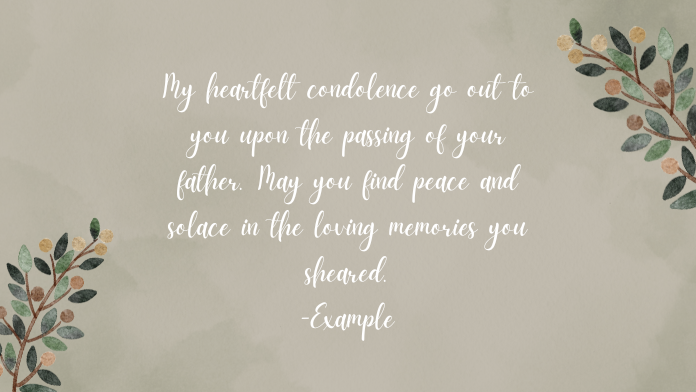
“I’ll never forget how your father always made everyone feel welcome. He truly had a gift for kindness.”
Personalization makes your message stand out from generic condolences and reminds the recipient that their loved one is remembered fondly.
Step 3: Offer Comfort, Not Solutions
Avoid trying to “fix” grief. Instead of saying, “They’re in a better place,” try, “I hope you find comfort in the love that surrounds you.” True empathy is not about explaining loss—it’s about sharing presence.
Step 4: End with Warmth and Support
Close with a thoughtful offer or comforting wish, such as:
- “Wishing you strength in the days ahead.”
- “Please know I’m here if you need someone to talk to.”
- “Sending love and prayers to you and your family.”
Step 5: Keep It Simple if Needed
If words fail you, a short condolence message is perfectly appropriate. A few heartfelt sentences can mean just as much as a long letter.
Condolence Message Examples for Different Situations
For a Friend
“I’m so sorry for your loss, my friend. I can’t imagine how painful this must be, but please know I’m here for you always.”
For a Family Member
“Our hearts ache with you. Aunt Clara was such a light in our family, and her love will continue to guide us all.”
For a Colleague
“My condolences on your loss. Wishing you peace and strength during this difficult time. Please take all the time you need.”
For Someone You Don’t Know Well
“I’m deeply sorry for your loss. Though we may not know each other closely, please accept my heartfelt sympathy.”
Religious Condolence Message
“May God give you comfort and peace in this time of sorrow. You and your family are in my prayers.”
Non-Religious Option
“Thinking of you and wishing you moments of peace as you remember your loved one.”
For Social Media or Text
“Sending love and strength your way. My condolences to you and your family.”
Each of these examples balances sincerity with simplicity—ideal for expressing sympathy across different relationships.
What to Write in a Sympathy Card
Writing a sympathy card adds a tangible touch to your care. While digital messages are convenient, a handwritten note often feels more personal and lasting.
Structure of a Sympathy Card Message
- Greeting – “Dear Sarah,”
- Condolence Statement – “I was heartbroken to hear of your loss.”
- Personal Memory or Acknowledgment – “Your brother’s laughter always brightened the room.”
- Words of Comfort – “May you find peace in the love of those around you.”
- Closing – “With love and sympathy, [Your Name]”
Tips for Writing the Card
- Use your natural tone; don’t overthink formality.
- Avoid clichés unless you truly mean them.
- Don’t make assumptions about faith or beliefs.
- If you promise support (“I’m here for you”), follow through later.
The Etiquette of Condolence Messages
Expressing condolences is about timing, tone, and sincerity. Here’s what good etiquette looks like in practice.
When to Send
Send a condolence message as soon as you hear about the loss—ideally within a few days. If you learn about it late, it’s still appropriate to reach out; a delayed expression of sympathy is better than silence.
How to Send
- Cards: Traditional and heartfelt.
- Email: Acceptable for professional or distant relationships.
- Text/Social Media: Suitable for close friends or quick messages of comfort.
- Phone Call or Visit: Best for family or intimate friends.
What to Avoid
- Comparing losses (“I know how you feel”).
- Offering advice (“You should stay strong”).
- Making it about yourself.
- Using overly religious or casual language if you’re unsure of beliefs.
The Power of “Sorry for Your Loss” — and What to Say Instead
The phrase “sorry for your loss” has become universal—but it can sometimes feel overused. If you want to express condolences in a more distinctive way, consider alternatives that sound more personal:
- “I can’t imagine how difficult this must be for you.”
- “Your loss deeply saddens me.”
- “My heart goes out to you and your family.”
- “I’m holding you close in my thoughts.”
- “Please accept my deepest sympathy.”
A message doesn’t have to be original to be meaningful—it just needs to sound like you.
Short Condolence Message Ideas
When you need to write something concise—perhaps in a card, email subject line, or bouquet note—these short condolence messages can help:
- “Thinking of you during this difficult time.”
- “With heartfelt sympathy.”
- “You’re in my prayers.”
- “Wishing you comfort and peace.”
- “With love and deepest condolences.”
- “May memories bring you strength.”
Even brevity can be beautiful when written with care.
Cultural and Religious Sensitivities in Condolence Messages
Different cultures and religions approach death uniquely, so your condolence message should reflect that awareness.
Christian Context
Often emphasizes hope, heaven, and eternal life.
“May God’s peace be with you as you remember your loved one.”
Muslim Context
Faithful Muslims appreciate phrases like:
“Inna lillahi wa inna ilayhi raji’un” (“We belong to God, and to Him we shall return.”)
Hindu Context
Focus on the soul’s journey and spiritual continuity.
“May the departed soul find peace and eternal rest.”
Buddhist Context
Gentle reminders of mindfulness and impermanence are appropriate.
“May you find peace in the memories and love that remain.”
Understanding these nuances shows cultural respect and emotional intelligence—key aspects of expressing empathy with grace.
How to Offer Support Beyond Words
Words are powerful, but actions amplify their meaning. After sending your condolence message, consider tangible ways to help:
- Deliver a meal or send flowers.
- Offer to help with errands or childcare.
- Attend the funeral or memorial service.
- Check in after the initial mourning period.
Grief doesn’t end after the funeral, and neither should your support.
Mistakes to Avoid When Writing Condolence Messages
Even with good intentions, certain phrases can unintentionally hurt or alienate. Here’s what to steer clear of:
- “They’re in a better place.” (Can feel dismissive.)
- “At least they lived a long life.” (Minimizes grief.)
- “Everything happens for a reason.” (Unhelpful during fresh grief.)
- “You’ll move on soon.” (Insensitive and rushed.)
- “I know exactly how you feel.” (No one truly does.)
Empathy doesn’t mean explaining away pain—it means sitting beside it quietly.
Modern Ways to Send Condolence Messages
In today’s digital world, sympathy can be shared through many channels. The medium matters less than the sincerity behind your words.
Keep it professional yet kind, especially in workplace settings.
“Please accept my condolences. I was saddened to hear of your loss and wish you strength during this time.”
Text
Short, heartfelt, and instant.
“Thinking of you today. Sending love and strength.”
Social Media
Public posts can offer community support, but respect privacy.
“Sending heartfelt condolences to the [Last Name] family. Wishing peace and comfort in the days ahead.”
If you’re unsure, send a private message instead of a public post.
Sample Templates for Inspiration
General Template
Dear [Name],
I was deeply saddened to hear about [Name]’s passing. [He/She/They] was such a wonderful person, and I will always remember [specific memory or trait]. Please know that you’re in my thoughts, and I’m here if you need anything.
With sympathy,
[Your Name]
Professional Template
Dear [Colleague’s Name],
I was sorry to hear of your recent loss. Please accept my condolences. May you find comfort in your memories and in the support of those around you.
Best regards,
[Your Name]
Close Friend Template
My dear [Name],
Words can’t express how sorry I am for your loss. I’m here for you, always—whether you need to talk, cry, or sit in silence. Sending all my love.
[Your Name]
Mini Summary: The Heart of a Condolence Message
A meaningful condolence message isn’t about eloquence—it’s about presence. When you take time to write one with genuine compassion, you give a small piece of peace to someone navigating deep pain. Remember: sincerity outweighs sophistication, and empathy always finds its way through the simplest words.
Conclusion
Expressing sympathy can feel intimidating, but the truth is simple: there’s no perfect condolence message—only sincere ones. Whether you send a short note, a heartfelt card, or a few quiet words, what matters most is the intention behind them.
When you write with empathy, respect, and authenticity, your words become a soft light in someone’s darkness. So the next time someone you know faces loss, don’t hesitate to reach out. A few sentences from your heart might mean more than you’ll ever know.
FAQs
1. What is a condolence message?
A condolence message is a written or spoken expression of sympathy offered to someone grieving the loss of a loved one.
2. How do I start a condolence message?
Begin with empathy—say you’re sorry for their loss and mention the deceased by name if possible. Example: “I was heartbroken to hear about John’s passing.”
3. What should I avoid in a condolence message?
Avoid clichés, unsolicited advice, or phrases that minimize grief (e.g., “It’s for the best”). Keep your tone gentle and respectful.
4. How long should a condolence message be?
It can be short or long. Even two heartfelt lines can be powerful if they come from a place of sincerity.
5. Can I send a condolence message by text or email?
Yes. For close friends or colleagues, digital messages are perfectly acceptable, as long as they’re thoughtful and personal.
6. What’s the difference between a condolence message and a sympathy card?
A condolence message is the content—the words of comfort—while a sympathy card is the medium through which it’s sent.
7. How can I make my condolence message sound genuine?
Use your own voice. Focus on empathy, mention personal memories, and avoid trying to say “the right thing.” Authenticity is what makes it meaningful.
Yo, I heard about xjwinbet from a friend. Seemed alright. I didn’t win big, but didn’t lose either. Worth a punt if you’re feeling lucky. Head over to xjwinbet and see what you think.
Woah! I’m really digging the template/theme of this blog. It’s simple, yet effective. A lot of times it’s difficult to get that “perfect balance” between usability and visual appearance. I must say that you’ve done a great job with this. Also, the blog loads super fast for me on Opera. Exceptional Blog!
toyydptsrzhsvgztfjdnsiqmfguqqd
Been bouncing around different sites and this one keeps me locked in. The mobile experience is incredibly fast even on older phones and the live dealer rooms never lag. I really appreciate how transparent they are about payout times. vn13win1
I’ve tried a few sites lately but this one really stands out. The games load fast and the payouts are legit. Highly recommend checking out fk77casino for a great experience.
If you are looking for a platform that actually pays out on time then this is it. Everything is transparent and fair. Big wins at br333win!
Love the local vibe of this site. It feels tailored for us and the customer support is actually helpful. Glad I found phauronplay.
Best platform for local players in the Philippines. It feels tailored to our needs and the bonuses are legit. Big thanks to 77jiliph for the awesome setup.
Fast login and an amazing variety of games to choose from. I spent the whole evening here and had a blast. Check out 32jilicasinologin
Always a blast playing here. The promotions are always fresh and the community is great. I’m really happy with ph3taya365.